蒙古青年论坛

 找回密码
 注册
查看: 1345|回复: 12

匈奴考古学进入新世代-Xiongnu Archaeology Enters a New Century

[复制链接]
发表于 2008-12-19 15:44:39 | 显示全部楼层 |阅读模式
http://depts.washington.edu/silk ... iongnuarchhist.html

Xiongnu archaeology is now more than a century old. As a complement to the International Conference on Xiongnu Archaeology scheduled for October 16-18, 2008 in Ulaanbaatar, we offer here a selection of images with brief commentary to illustrate some of the excavations beginning with the pioneering work of Iu. D. Tal'ko-Gryntsevich. It would be easy to criticize the methodology of the early excavators, but as with most archaeology what we have here is a remarkable record of progress in both method and understanding of the material. This page makes no pretense at completeness-some important excavations are not illustrated, notably the work which has been done in China. The selection has been influenced to a considerable degree by the availability of appropriate images on short notice. References to important publications of results may be found in the separate bibliography linked here.

       
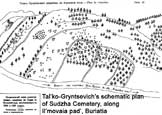
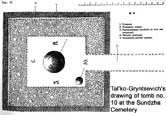
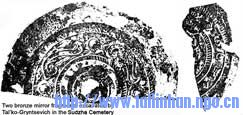
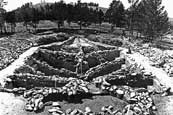
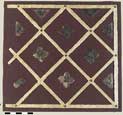
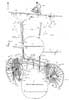
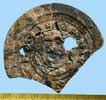
The first modern excavations of Xiongnu sites were undertaken by Iu. D. Tal'ko-Gryntsevich between 1896 and 1902 in the south of Buriatia, near the border with Mongolia. He identified and drew at least schematic maps of many of the important Xiongnu cemeteries which have subsequently been the focus of work by Russian and Buriat archaeologists. His tomb excavations, while far from meeting any modern standard, uncovered numerous artifacts, and he provided the earliest (if somewhat idealized) drawing of the surface structure of a square ramped Xiongnu tomb.

[ 本帖最后由 蓝天雄鹰 于 2008-12-19 16:25 编辑 ]
tgmap_a_th.jpg
tgplan_a_th.jpg
tgmirror_a_th.jpg
 楼主| 发表于 2008-12-19 15:45:29 | 显示全部楼层
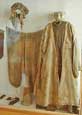
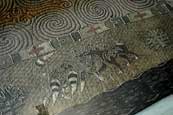
Perhaps the still most famous Xiongnu tombs are those at Noyon uul (Noin Ula), the mountain in north central Mongolia, a site first identified in 1912 and then first excavated seriously beginning in 1924 under the supervision of S. A. Kondrat'ev and S. A. Teploukhov, who were part of the Tibeto-Mongolian expedition led by the famous Russian explorer Pyotr Kuzmich Kozlov. The remarkable achievement of the first excavations at Noyon uul was their retrieval of a wide range of organic materials, which had been preserved thanks to the tombs having been flooded. The Noyon uul burials of Xiongnu elite were nested wooden chambers, hung with textiles. Many items of clothing were preserved. A Chinese lacquerware cup with a date of 4 CE provided a terminus post quem for one of the graves. Excavations at Noyon uul were resumed by Mongolian expeditions led by Kh. Perlee and Ts Dorjsuren in the mid-1950s. A joint project involving the well-known Siberian archaeologist Natalya Polos'mak has continued work at Noyon uul in recent years. A selection of the Noyon uul finds may be viewed today in the Hermitage Museum in St. Petersburg and in the National Museum of Mongolian History in Ulaanbaatar.
hermitagenoinula3a_th.jpg
 楼主| 发表于 2008-12-19 15:48:12 | 显示全部楼层
A good many of the other important excavations of Xiongnu sites in recent years have been joint undertakings of Mongolian archaeologists and institutions on the one hand and foreign experts and organizations on the other. For example, there has been noteworthy collaboration between Mongolian and Korean archaeologists studying a broad chronological range of sites, some of the most significant being ones from the Xiongnu period. A special exhibition marked five years of this collaboration over the period 1997-2001.
hermitagenoinula5a_th.jpg
hermitagenoinula6a_th.jpg
hermitagenoinula13a2_th.jpg
ubhist056a_th.jpg
ubhist057a_th.jpg
ubhist058a_th.jpg
 楼主| 发表于 2008-12-19 15:51:22 | 显示全部楼层
The Mission archlogique franise en Mongolie has joined in excavations at Egiin Gol and, most famously, at Gol Mod 1. While we do not illustrate these here, images and information may be found on the mission's website and in an excellent book published in 2003. The ramped Tomb no. T1 at Gol Mod 1 is one of the largest Xiongnu elite tombs excavated to date. It yielded a rich array of artifacts, including the remains of a Chinese chariot.
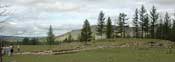
American archaeologists have been active collaborators in projects in Mongolia for more than a decade. Pioneering work there in the area of settlement and landscape archaeology has been undertaken by William Honeychurch (Yale University) and Joshua Wright (Stanford) at the northern Mongolia valley of Egiin-gol and the northern Gobi area of Baga-gazriin-chuluu. Their work has opened many avenues of research for Iron Age Mongolia. Among the expeditions involving American participation, we note also the work at Gol Mod 2, a site in the Khanuy River valley in north-central Mongolia, where the major tombs await excavation. The ramped tomb No. 1 is the largest Xiongnu tomb yet discovered. The arc of 27 satellite burials along its east side was excavated in 2002, 2004 and 2005 and proved to be remarkably rich, the data contributing to a rapidly growing interest in studying tomb complexes and not just the main burials.
golmod2mirrors2_th.jpg
golmodtwoa_th.jpg
 楼主| 发表于 2008-12-19 15:54:30 | 显示全部楼层
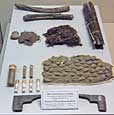
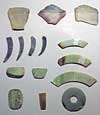
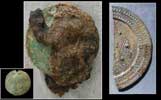
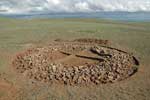
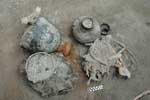
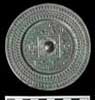
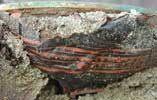
he Silkroad Foundation, a co-sponsor of the October 2008 conference, has been a partner in excavations of Xiongnu sites in Mongolia in 2005, 2007 and 2008. The first of these collaborations, with the National University of Mongolia, focussed on a large Xiongnu Cemetery at Tamiryn Ulaan Khoshuu, not far from where the Tamir river enters the Orkhon. Five graves were excavated, yielding a wide range of artifacts, including much evidence of Xiongnu interaction with China - coins, lacquerware, and bronze mirrors. Preliminary investigation was also undertaken at a nearby "settlement" site, whose function and history await a major commitment to long-term study. It consists of three large walled enclosures, which were carefully mapped. Test pits yielded no artifacts.
tamir109_th.jpg
tamir97_th.jpg
mirror_th.jpg
tamir97lacquer_th.jpg
 楼主| 发表于 2008-12-19 15:58:04 | 显示全部楼层
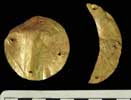
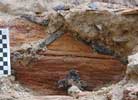
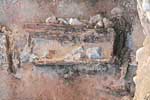
n 2007 and 2008, the Silkroad Foundation and National Museum of Mongolian History worked in the Khovd region of western Mongolia. The excavation in 2007 focussed on one major elite grave in at Takhiltin-khotgor, a cemetery a flat area between two river valleys: the Khoit (North) Tsenkher River and the Dund (Middle) Tsenkher River in Manhan sum (the site had earlier been studied by Ts. Dorjsuren and D. Navaan) and a number of satellite burials and ritual features, which shed new light on the nature of tomb complexes. Also, a preliminary field survey was done of the wider surrounding region, which is rich in archaeological material from various periods. The choice of Khovd was part of an effort to learn more about Xiongnu culture away from its presumed center in north central Mongolia and southern Buriatia.
sbrburial_th.jpg
sunandmoon_th.jpg
THL64decwestwall_th.jpg
aug6coffin_th.jpg
 楼主| 发表于 2008-12-19 15:59:07 | 显示全部楼层
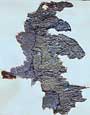
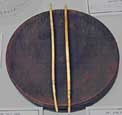
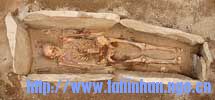
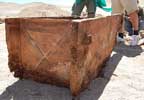
The 2008 expedition broadened the area of investigation to include other cemeteries. Of particular interest were the discoveries made at Shombuuzin belchir, in the nearby mountains. Some of the graves excavated there were unlooted, among them two stone cyst graves, one containing the mummified remains of a baby partially shrouded in cloth, and another with artifacts which included a complete set of bow plates and parts of the wood from the bow. A sizeable intact portion of a painted wooden coffin was also retrieved for the Museum's collections. Since the Takhilt excavation teams have included an expert conservator, Judy Logan, it has been possible to make advances in the field preservation of artifacts, including the fragile remains of lacquered objects which so often do not survive removal.
sbrburial_th.jpg
sbrpaintedcoffin_th.jpg
 楼主| 发表于 2008-12-19 16:00:32 | 显示全部楼层
Buriat and Russian expeditions have accomplished a great deal in the archaeologically rich territories of the Trans-Baikal region, a region which seems to have become important to the Xiongnu after the Han military successes against them in the early part of the first century BCE. Certainly one of the most significant studies was A. V. Davydova's excavation of Ivolga (not illustrated here), which to date is the most thoroughly examined Xiongnu settlement site, located near Ulan-Ude. As is so often the case, especially with "nomad archaeology," much of our archaeological record has come from burials. At Ivolga, there was a cemetery and also a fortified settlement site with the remains of permanent houses.

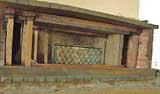
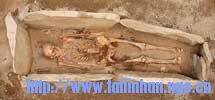
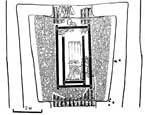
One of the now senior Buriat archaeologists, Prokopii B. Konovalov, supervised the excavation in 1971-76 of a major royal tomb (no. 54) in the Sudzha Cemetery, a site first explored by Tal'ko-Gryntsevich. Konovalov's was the first excavation of a Xiongnu square-ramped tomb to take careful note of the complex internal structure of such tombs. Unfortunately, this excavation has remained little known, due to the long delay in publication of the results. His book should appear in English in 2009.
pk2_th.jpg
pk3_th.jpg
pk4_th.jpg
 楼主| 发表于 2008-12-19 16:01:52 | 显示全部楼层
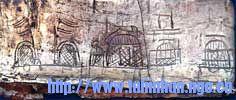
Finally, we note the striking results of the excavation of another major elite tomb in Buriatia, by Sergei Miniaev of the Institute of Material Culture in the Russian Academy of Sciences in St. Petersburg. Between 1997 and 2005, he supervised the excavation of tomb complex no. 7 at Tsaraam, just north of the border between Russia and Mongolia. The internal tomb structure, carefully documented in this excavation, was particularly complex, and the finds of artifacts particularly rich. Among the latter were the remains of a Han Chinese chariot, numerous fragments of Han mirrors which had been ritually broken and fired, and several "sacrificial dolls," constructed around the real skulls of babies. There were finds of lacquer and gold, a birchbark box with an incised picture of nomad gers, and much more. Miniaev is one of several Russian scholars (others located in Novosibirsk, Ulan-Ude and Vladivostok) who have been making major contributions to Xiongnu studies in recent years. Miniaev's website contains valuable information on Tsaraam and his ongoing work.
tsaraamchariot_th.jpg
tsaraammirror2_th.jpg
tsaraamnomadcampimg_th.jpg
 楼主| 发表于 2008-12-19 16:02:19 | 显示全部楼层
As Xiongnu archaeology enters a new century, the prospects for major advances in our understanding of this nomadic polity and society which were so important in the early history of Eurasia are better than ever. It can be hoped that the conference in October 2008 will not only provide a full assessment of the "state of the field" but will also lay the basis for even broader international collaboration.

Daniel C. Waugh
University of Washington (Seattle
发表于 2008-12-19 16:07:43 | 显示全部楼层
Xiongnu?
Hünnüüd!
 楼主| 发表于 2008-12-19 16:28:49 | 显示全部楼层
美国,俄罗斯,蒙古国等考古学家都是这样写的
蒙古
http://www.mas.ac.mn/en/index.php?option=com_content&task=view&id=50&Itemid=1
美国
http://depts.washington.edu/silkroad/archaeology/mongolia/xiongnu/conference/confoct2008.html
俄罗斯
http://www.archeo.ru/eng/themes/xiongnu/biblio.htm
 楼主| 发表于 2008-12-19 16:29:45 | 显示全部楼层
原帖由 litkt 于 2008-12-19 16:07 发表
Xiongnu?
Hünnüüd!

美国,俄罗斯,蒙古国等考古学家都是"xiongnu"

蒙古
http://www.mas.ac.mn/en/index.php?option=com_content&task=view&id=50&Itemid=1
美国
http://depts.washington.edu/silkroad/archaeology/mongolia/xiongnu/conference/confoct2008.html
俄罗斯
http://www.archeo.ru/eng/themes/xiongnu/biblio.htm
您需要登录后才可以回帖 登录 | 注册

本版积分规则

Archiver|手机版|小黑屋|蒙古青年论坛

GMT+8, 2026-7-25 02:09 , Processed in 0.014670 second(s), 17 queries .

Powered by Discuz! X3.4

© 2001-2023 Discuz! Team.

快速回复 返回顶部 返回列表